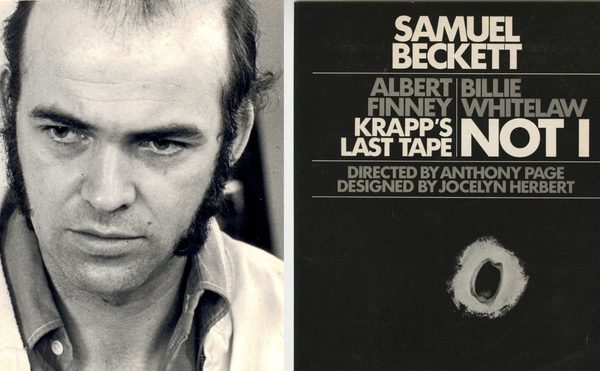
Anthony Page, 1935 - 2026
News Story
Anthony Page, 1935 - 2026
It is with great sadness that the English Stage Company today marks the legacy of one of the defining directors of the Royal Court’s early history and our former Artistic Director, Anthony Page.
Anthony first joined the Royal Court as an Assistant Director in 1958, only two years after the English Stage Company arrived in Sloane Square. For the next fifteen years, Anthony remained closely associated with the theatre – supporting and directing some of the landmark Court productions of our first generation.
When our founding Artistic Director, George Devine, fell ill in 1964, it was Anthony who stepped forward to take on the artistic leadership of the English Stage Company through what could have been a challenging and turbulent transition. Immediately directing John Osborne’s INADMISSIBLE EVIDENCE, starring Nicol Williamson, Anthony’s production was a major success, transferring to the West End, and cementing the relationship between Anthony and John Osborne that would lead to many further, fruitful collaborations.
Most notably for the Court was A PATRIOT FOR ME, which opened in Sloane Square Court in 1965. In defiance of the Lord Chamberlain, which refused to license Osborne’s play without substantial cuts and changes, the Royal Court reimagined itself as a private members’ club – a legal loophole that allowed audiences to see Page’s production and Osborne’s script uncut under the guise of them not being ‘public performances’. It was the beginning of a long battle between the Royal Court and the Lord Chamberlain which would, eventually, bring about the end of state censorship in England.
As well as Osborne, Anthony’s other significant and regular collaborator was Samuel Beckett. Anthony directed WAITING FOR GODOT at the Royal Court in 1964, again starring Nicol Williamson – who had also featured in INADMISSIBLE EVIDENCE – and, perhaps most famously, he directed the British premiere of NOT I in 1973. Under Anthony’s direction, Billie Whitelaw’s mouth, suspended and tightly lit in total surrounding darkness, became one of the most enduring and iconic images of twentieth-century theatre.
From 1969 to 1972, Anthony shared the Artistic Directorship of the Royal Court with William Gaskill and Lindsay Anderson, helping to lead the English Stage Company through a crucial period in our history.
While Anthony’s work at the Royal Court is foundational to the English Stage Company, his successes were by no means limited to Sloane Square. He enjoyed an extraordinary international career across television, film and theatre. His celebrated production of A DOLL’S HOUSE on Broadway won him the Tony Award for Best Direction of a Play in 1997, while his acclaimed BBC adaptation of MIDDLEMARCH in 1994 remains one of his best-known achievements on screen.
Anthony’s skill, talent, and leadership are baked into the foundations of the modern Royal Court. He belonged to the generation that established the blueprint for what a writers’ theatre could be, and how directors could best put themselves at the service of that vision. Shaping a fearless period in British theatre, standing at the centre of battles for artistic freedom, Anthony paved the way for the Royal Court we treasure today.
He leaves behind an extraordinary legacy and body of work. He will be deeply missed but never forgotten.