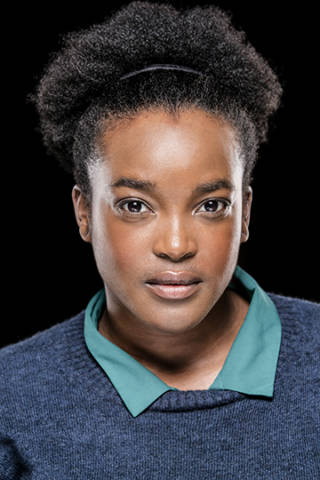
The Vertical Hour
Writer David Hare and director Jeremy Herrin in discussion with the Royal Court’s Diversity Associate, Ola Animashawun.… Read more
The Royal Court Theatre presents
By David Hare
17 January - 1 March 2008
Jerwood Theatre Downstairs
Tickets: £25, £15, £10. Mondays all seats £10. Concessions £10.
"It's a choice isn't it? How you live. How you behave. At some point in your life you make your choice. Maybe you don't even remember. Everything conspires to make you forget. But the choice is there. You made it."
Nadia Blye knows exactly what her stance is on Iraq. A former war reporter and Professor of International Relations at Yale, she has advised the President and seen action in Sarajevo and Baghdad. She is sure of her place in the world and her opinion of it.
Until, that is, she meets an equally opinionated and lethally charming man – her boyfriend’s father – over a weekend in Shropshire. His intervention has far-reaching consequences for them all.
‘If you want a definition of good drama, this is it a rich, intellectually gripping play.
— Guardian
David Hare’s play, pitting personal philosophies against global politics, premiered on Broadway in 2006, and now receives a new production and its UK premiere at the Royal Court. His best known plays include Plenty, Skylight, Racing Demon, Via Dolorosa and Stuff Happens.
Jeremy Herrin directs a cast including Indira Varma who is best known for her roles in The Whistleblowers (ITV), Rome (BBC/HBO) and The Vortex (Donmar).
… a wonderful achievement in a major, unmissable theatrical event.
— Whats On Stage
Superb, emotionally charged performances.
— Evening Standard
Writer
Director
Designer
Lighting
Music and Sound
5 stars Jane Edwardes, Critics’ Choice, Time Out 28th January 2008
Politics is crucial to David Hare’s new play but it is not, as has been described, a play about the Iraq war. Rather, Hare is returning to a theme that has always obsessed him that people will go mad if there is too great a discrepancy between what they believe and how they live their lives. Nadia, a brilliant, and, yes, beautiful, American war correspondent turned academic, is trying to settle quietly with Philip, a British physiotherapist who has fled his parents to live in the States. It takes a trip to the Border country to meet Oliver, Philip’s father, to make her reassess her life.
Iraq enters the equation in that Nadia supports American intervention. Oliver, who is a classic British liberal, thinks otherwise. Hare has often articulated ideas in his plays that have only hovered in the air before. But here the arguments are very familiar. More interestingly, he presents a triangle in which it’s the son who becomes increasingly left out as Nadia and Oliver, whose marriage broke up because of his relentless philandering, are drawn to each other over a long summer’s night. Drink and the hour make their outpourings just about credible. Mike Britton’s design washes the stage in a single colour so that nothing distracts attention from the three protagonists and its a measure of the playwrights ability to inhabit his characters that he can so eloquently present such varied points of view.
That said, this play will do nothing to convert Hare’s many detractors who feel that he exceeds Bernard Shaw in his ability to deal in issues rather than life. Those people are surely blind to the subtlety of Hares changing moods. The characters may not leap about but there is plenty going on emotionally ‘underneath’ – a much used word in the play – which is gracefully illuminated in Jeremy Herrin’s production, particularly by Anton Lesser as Oliver and Indira Varma as Nadia.
4 stars Michael Coveney, WhatsonStage.com, 23rd January 2008
Before the dawn comes up, on a hill overlooking Shropshire in the Welsh borders, an American academic tells a British doctor that ‘‘the vertical hour’‘ is that moment in combat, after a disaster, after a shooting, ‘‘when you can actually be of some use’‘. What are the practical responsibilities of medicine? What, indeed, is the best treatment for political wounds?
Nadia Blye (Indira Varma) is visiting Oliver Lucas (Anton Lesser) on a break from Yale. She carries with her the impact of her experience as a war correspondent in the Balkans and a mixed bag of feelings about the war in Iraq which, in the initial stages, she has supported. She has travelled to Britain with Oliver’s son, Philip (Tom Riley), a physical therapist who is scarred in a different way, by his family background.
David Hare’s play was premiered on Broadway in late 2006 with Bill Nighy and Julianne Moore in a production by Sam Mendes. Reports were mixed. Jeremy Herrin’s admirable new staging in Sloane Square is a triumph of clarity, sensitive, well-judged acting and supple argument propounded with intelligence and passion. If the occasion doesn’t achieve full theatrical combustion it is because the actors are projecting more of the play than themselves. The equation may not yet be quite perfect.
But this is, undoubtedly, one of Hare’s best plays, a mature blend of the personal and the political. Almost every line makes you think. The playwright allows less time than usual for his trademark jokes. The characters are drawn inexorably to the light of their own realisation: that teaching politics isn’t enough; that having a view of the world may not be enough; that we must take responsibility for our actions, or lack of them.
Oliver’s dark secret is one of causing death. His larger guilt has to do with the life he led, the betrayal of his wife, Philip’s mother. Nadia has escaped into a relationship with Philip because it’s the easy option. The war in Iraq is a flashpoint for decision-making at home. The Shavian scheme of the central body of the play is book-ended by two classroom scenes (Joseph Kloska and Wunmi Mosaku are the students) in which Nadia confronts complacency over American imperialism and despair over its foreign policy; how the latter replaced the former, in American public life, gives the play an extraordinary transatlantic cultural resonance.
It is possible that Oliver, the great seducer, wants to prise Nadia away from his own son. Instead, he succeeds in helping her articulate what she feels about our indifference to war, as well as to people. The play as only drama can do makes sense of global anxieties in the tiny detail of our own lives. And makes those lives seem important, too. This in itself is a wonderful achievement in a major, unmissable theatrical event. – Michael Coveney
Thrilling contest of wills between matched opponents 4 stars Michael Billington, Guardian, Wednesday January 23, 2008
Plays change. When I saw David Hare’s work on Broadway in 2006, I was struck by the sustenance it offered to its audience’s disaffection with the Iraq war. Now, seeing it in Jeremy Herrin’s infinitely superior Royal Court production, I am far more impressed by its subtle dissection of what Auden called “public faces in private places” and its demonstration of the dangers of divorcing politics from psychology.
Hare’s theme is the emotional education of Nadia Blye: a war-reporter turned professor who, as a result of bitter experience in the Balkans, is a passionate advocate of humane intervention. On a visit to Shropshire to meet her male friend’s father, a damaged liberal idealist, she finds her iron certainties severely tested. Not only does she encounter an intellectual equal who challenges her on everything from patriotism to Freud, she also learns you cannot separate public and private, or spend your life in flight from your self.
That makes the play sound didactic. Part of Hare’s achievement is to surround it with sexual tension in which you are never sure whether the father, Oliver, is out to seduce Nadia or to change her. Hare also follows the Shavian practice of giving comparable weight to contradictory ideas. Nadia’s arguments for interventionism derive from horror at the west’s indifference to global suffering. They are countered by Oliver’s critique of the dubious rationale of the Iraq invasion and its disastrous consequences. If you want a definition of good drama, this is it: the confrontation of two ultimately irreconcilable ideas both eloquently stated.
Hare’s play is not perfect: the US scenes bookending the action of Nadia with her students, are more point-scoring than plausible. And her final gesture strikes me as romantic. But this is still a rich, intellectually gripping play that gains immeasurably in London from the balance between the two performances. Indira Varma’s excellent Nadia has an intellectual and physical poise that buckles as she acknowledges her frailties and the world’s imperfections. And, where Bill Nighy’s charisma was dominant in New York, Anton Lesser plays Oliver as a testy interrogator, delighted to do battle with his son’s lover, but reveals his solitary vulnerability. Tom Riley also articulates the son’s Oedipal hang-ups in a production which, played on a bare stage, offers a thrilling contest of wills between two perfectly-matched opponents.
3 stars Paul Taylor, The Independant, Thursday 24th January 2008So a Broadway opening, directed by Sam Mendes in November 2006 with American film star Julianne Moore as the lead, had a certain symbolic appropriateness. The trouble, though, was that Moore was miscast, coming across more as an agonised mature student than an outwardly forceful professor and Bill Nighy, demonstrating his trademark tics as though he were being paid on some quota system, wiped the floor with her in debate. Indira Varma and Anton Lesser are much more evenly matched now in Jeremy Herrin’s beautifully nuanced and well-paced UK premiere at the Royal Court.
Under the artistic directorship of Dominic Cooke, this famously left-wing and oppositional theatre has begun to subject liberalism to searching scrutiny. Last summer, the lip-service idealism of well-heeled, soi-disant American liberals was satirically excoriated in The Pain and the Itch. Now, through the high-minded scorn of Nadia, the Yale professor who backed the invasion of Iraq as a humanitarian crusade and even briefed Bush, the kind of self-hating liberal who champions the right of others to hate the West (“If I were them, I’d hate us too”) is examined and challenged.
The success of the evening is largely due to Varma’s superb performance. Projecting both the combative humour and the emotional confusion of this feisty young woman, she makes the character’s contradictions feel complex rather than (as Moore did) clunkingly inconsistent.
Nadia is a temperamental cousin of Susan Traherne, the Resistance heroine whose frustrated idealism turns destructive during the compromises of the post-war years in Hare’s Plenty. The difference, as Varma vividly delineates, is that Nadia is consciously torn between distrusting her own addiction to angry self-righteousness and an absolutist desire to break loose from pampered, materialistic modernity that betokens (in ways that Hare under-explores) certain temperamental affinities with Islam. When the doctor, quoting from Henry V, argues that “The West’s been using Islam as a useful enemy for as long as anyone can remember”, it feels like a dramaturgical cop-out that she fails to respond.
I never believed that Nadia would have looked twice, still less embarked on a relationship with Tom Riley’s cipher of a physical therapist. Nor is it easy to credit that Nadia can have seen at first hand the terrible consequences of the invasion of Iraq and still resist acknowledging that the intentions of the invaders helped to shape those consequences.
In the first half, Lesser’s lack of seductive sex appeal as the doctor with the guilty past lowers the charged edginess of his encounters with Nadia. But Herrin’s production builds up by stealth an intensely absorbing atmosphere of mutually revealed pain in the long al fresco sequence where the two of them talk and drink until dawn and shock each other into self-knowledge. All of the characters are in flight from their haunted inner lives.
The Vertical Hour shows that it’s deluded and damaging to suppose that you can set aside personal agonies and equally harmful to view the outside world as a projection of private passions. So how do you relate the inner to the outer? This difficult question that animates a play that is sometimes schematic but which, as sensitively and subtly realised here, will continue to nag the mind long afterwards.
Boy, are they articulate. But the focus is hard to see
The Times
Benedict Nightingale
Wednesday 23
3 stars Funny how a switch of place and time can also change ones view of a play. When I saw David Hare’s The Vertical Hour on Broadway in late 2006 it seemed to me mainly about Iraq. As far as I and others were concerned, it might have been a fictional follow-up to his Stuff Happens, the docudrama that brought actors playing Dubya, Rummy and Condi to the National stage. But though there was still some discussion of the Iraq war at its British premiere last night, it seemed just one of several topics that allowed Hare to do something nonpolitical: take a good look at the ravelled psyches of his main characters.
Tom Rileys Philip brings Indira Varmas Nadia from America, where he’s a ‘‘physical therapist’‘, to meet his father, Anton Lesser’s Oliver, a doctor who lives alone in remote Shropshire.
But she’s no ordinary girlfriend. She’s a war correspondent turned Yale academic and one of the strong, interesting women in whom Hare has long specialised. More than Julianne Moore, who created the role in New York, Varma brings mind, spirit and a hint of vulnerability to an ultra-articulate character.
Because, boy, are she and Oliver articulate. This is a house in which, before they sit for a post-introduction coffee, they’re talking about the motives behind terrorism and the limitations of materialism. Indeed, the subjects aired during a long day’s journey into night include Freud, patriotism, Western decadence, the importance of the American presidency, corrupt politicians, marriage, sexual ethics, the 1960s, preventative medicine, feelie culture, the possibility of objectivity and what can be done about suffering.
You could call the play discursive, because it is, very. You might also call it evidence of Hare’s most attractive qualities: his questing curiosity, his lively intelligence. But the focus remains hard to see. Perhaps it’s about how private feelings shape our public opinions and vice versa. Perhaps it’s about the need for negotiation in both spheres. Perhaps it’s about the difficulty of knowing who we are and what we want.
Certainly it’s about families, here represented by a powerful father, a son who fades in his bright light and a mad offstage mother.
The trouble is less with the debates you feel Hare is having with himself, more with the plausibility of his private world.
Would this brilliant woman get off with as dull, childish a man as Philip? It isnt being ‘‘true to myself’‘ to leave him after being hit by Lesser’s mental and sexual voltage. Its just being painfully predictable.
And Iraq? Well, Nadia has been in favour of the invasion, thinking evil must be faced and beaten. Oliver is fiercely against, for all the obvious reasons, leaving her wanly to concede its all ‘‘a mess’‘. Hare is fair-minded enough to let her put her case, but there’s no doubt where he too stands. Not pro-war.
Writer David Hare and director Jeremy Herrin in discussion with the Royal Court’s Diversity Associate, Ola Animashawun.… Read more
Box Office: 020 7565 5000
Administration: 020 7565 5050
Principal Sponsor: Coutts